
I’m crazy about wordplay and hidden meanings. Yet after 18 months in Paris, the jeux des mots that transform ad campaigns into micro-comedies still evade me. While I might spend metro time trying to slog through an article in Le Monde or Figaro, I rarely bother with billboards splayed along the way.
I suppose I must come clean about one instance in which I spent the entire time the train was stopped at a station puzzling over a massive, blood red poster for a best-selling murder mystery. The two key elements of the title – ‘law’ and ‘eye’ (as in eyewitness?) – fit perfectly with a crime story, but for the life of me, I could not string them together in the book’s title. As the train pulled way, I noticed that the red slit in the pupil of the poster’s moon-sized black eye was, in fact, a dagger in silhouette. Something clicked, and I remembered that ‘droit’ might be ‘law’ or might be ‘right’. I can well imagine that my own face turned a deep crimson while I had a private laugh about how hard I had worked to get to from “Droit dans l’oeil” to “Right in the eye”.
Today, I’m in a funk. It’s Friday afternoon but spring is slouching under November’s heavy grey coat. I’m carting an awkward portfolio case and a loaded canvas bag—both bad-day black—down a loud, piss-stinky stairway.
Waiting on the quai, I feel the frustration of a fruitless darkroom session sagging between my shoulder blades. It’s been two months since I opted out of a stressful job that was killing my creativity. Now I’m finding out that creative work carries its own crap. True, you have the freedom to pursue your own ideas and to work at your own pace. But the reality of going solo is that there is no paycheque unless the work is really done. I can ill afford the wasted time and darkroom rental fees, never mind the expensive stack of photo paper I just tossed in the trash. Plus, I’m failing to deliver on my first commissioned project.
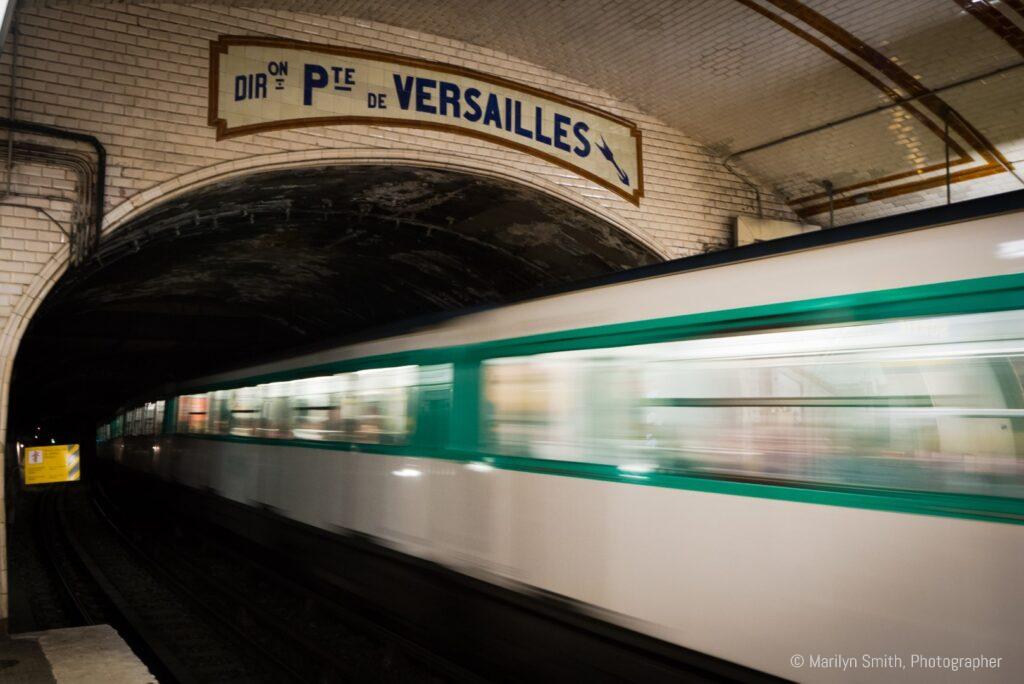
The metro arrives. I jostle my load through the closest door and slump into the nearest fold-down seat. Not because the car is crowded. I just can’t bother to walk any further. Nor can I muster the energy to dig out my half-read newspaper. I waver between wallowing in this miserable moment and willing myself to move beyond it until a forceful black square suspended above the centre aisle catches my attention. Scratchy white lettering, emulating a rushed, hand-written note, says simply:
“Vous êtes gentille, Marilyn, mais je vais vous laisser, merci pour le verre.”
For a brief moment, I feel like those women you see in movies or read about in papers…the ones who suddenly find a marriage proposal flashing across the electronic scoreboard at the baseball stadium. Well, kind of the opposite, really, considering the rough translation that comes to mind:
“You’re really nice, Marilyn, but I’ve gotta’ run. Thanks for the drink.”
Still, the same sense of bewilderment creeps over me. Is this some kind of joke? Who did that? Who would have gone to the trouble of having that sign printed and hung, and how would they know I would be in this car at this time of this day?
Some capricious neuron in my subconscious leaps out of the gate, eager to stretch the limits of this mildly amusing moment. First, there is the simple fact that some agency chose to turn the ‘story of my life’ into an ad campaign.
Why me? I’ve never seen my name used in advertising, anywhere. Stumbling across myself here seems particularly odd: Wouldn’t Parisian consumers connect more readily with an Elisabeth or a Marie-Louise? And what about the spelling? French people always write my name as Marylin, Maryline or Marilyne. But there it is, just plain old me.
By now, I can visualize the ad agency’s creative team, an eclectic gaggle of chic espresso drinkers clad in black and hovering around a sleek maple table. Some recline in the red retro chairs, others lean into the energy field, heads propped on the fist points of elbow-sided isosceles triangles. One, fully armed with felt markers and sponge eraser, paces in front of the white board.
Like kids with a basket of rubber balls, they lob ideas with easy abandon, challenging their counterparts to boost the momentum of one concept or toss something new into the mix. The ‘nice girl’ pitch keeps popping up but never quite manages to stay afloat.
In frustration, a lanky young intern slaps the table. “What is her name?” he demands, darting a blue ball toward the tattooed waif sitting at centre left. She hesitates slightly: ‘Becky?’ The enthusiasm catches: as quickly as lips can drop names, the ball zigzags round the room: Debbie. Tracey. Amy …what one might call the ‘ee-girls’.
Suddenly, a long, lean arm snatches the ball out of play.
“It’s not just about her name,” says the resident philosopher, twiddling a frayed cuff on his faded turtleneck, “it’s who she is.” As details emerge — pretty but plays it down, bright but reserved, fun but holds back from being overtly flirtatious, just turned forty — the team collectively hauls this mythical woman into their bosom. They prod and poke her. Ingest, chew and digest her. When they finally burp out the single phrase that encapsulates her existence, smug smiles break out all around.
It dawns on me that the creative team captured an incredibly clever subtlety. Of course she became a ‘Marilyn’ type. After all, ‘ee-girls’ (and whoever their French equivalents might be…Sophie? Julie? Fifi?) don’t just get ads, they get men.
What the agency couldn’t possibly know is that, in its final execution, this concept replicates the innocent act that sparked my latest infatuation, drops it in an uncannily apt context and bull’s-eyes its current status.
Moments before noticing the ad, I’d been making a mental list of possible attendees for my party the following night. Due to server problems at the office, I’m screwed. I have no clue who actually received the e-mail invitation or whether they tried to respond.
Eric, the subject of my current romantic musings, presents a special case. Our last interaction ended on a note of uncertainty and my first impulse was to leave him off the guest list. After moping it over for a couple of days, I attached a one-line note and forwarded a copy of the mass invite, still aware that clicking ‘Send’ offered no guarantee of delivery. Maybe there’s something to be said for the days when messages were hand-written and hand-delivered — setting the expectation of an equally tangible reply.
Part of the problem is that the ad sends me on a six-month flash-back to a cool, windy evening in late October: I’m standing, shoulders hunched, in front of the Theatre de la Ville. An attractive Asian man points to the text I’ve scrawled on a page torn from my day-timer and asks, in perfect English, “Are you buying or selling?”
“Cherches 2 billets” seems rather straightforward (even though our good friend Larousse lists variations from ‘search, seek, hunt for, court, ask for and look for’, nothing as mind-bending as ‘law’ and ‘right’). So I assume he’s in Paris on business and has a free evening to kill. ”Trying to buy,” I reply, nodding sceptically toward the clusters of competition dotting the sidewalk.
“How much do you think you’ll get stiffed for? Last time I saw the Kronos Quartet in San Francisco, it cost me $40 US.”
“Ah! It’s not like that here,” I say. “I’ve often managed to get last-minute seats at less than the ticket price.” And almost on cue, an elderly gentleman approaches and offers two tickets for 30€, six below cost. I explain that I’m meeting a friend and take both.
“Looks like your sign works…mind if I borrow it?” says the Asian man, at the same time introducing himself as Eric. I scratch out ‘2’, pencil in ‘1’ and hand it over. Shortly after he succeeds in securing a ticket, my friend arrives and the three of us agree to grab a drink before curtain time.
Eric has just finished Week One of a nine-month project for a high-tech firm. Given his easy social skills, it doesn’t surprise me that he’s in marketing. A quick ticket check as we re-enter the theatre confirms that our seats are on opposite sides. Eric apologizes: he doesn’t yet have a business card. I offer mine and we wave an ‘au revoir’ kind of good-bye. Even my friend has a hunch that I’ll be seeing this man again.
As we remove our coats and settle in, she and I laugh about all the modern tools—social clubs, expat associations, online dating services — designed to help middle-aged singles link up and wonder if we shouldn’t just spend more time in ticket lines.
A couple of weeks later, I’m back from a business trip and delighted to find that Eric has called. Through a series of e-mails, we arrange to have dinner at a place I know of midway between his new neighbourhood and mine.
I discovered Le Bistro d’Hubert during a weekly ritual I’d undertaken shortly after arriving in Paris. To live in France is to be immersed in a culture where social life revolves around family, friends, food and fine wine. But even single people need to eat. And I chose to try a new restaurant once per week, actively pursuing what could be acquired on demand — confident the rest would arrive in due time.
Justly or not, the word ‘ritual’ often shoulders a sense of pain and gain, and that Friday night was no exception. It was the second weekend of the ‘canicule’ of July 2003. Ten days of +40°C temperatures had drained any thought of cooking from my mind, mere eating would be effort enough. I opted for a slow amble through nearby streets, partly to create my own private breeze, partly as a means of postponing the sleepless hours still to be spent in an airless, sauna-hot apartment.
At first glance, le Bistro d’Hubert scored three positive hits: shady side of the street, wall-to-wall front awning, and plate-glass windows thrown wide open.
I selected the lightest choices from the menu du jour and settled into my uneasy routine. One hand caressing the slender green neck of an icy San Pellegrino, I cracked open the book that would be this evening’s dinner companion. A few pages along, the waiter came to deliver a salad and refill my glass of rosé.
I knew immediately that a vigorous chew would only add to the stipple of sweat gathering at the base of my neck. I let every morsel lounge on my tongue and listened intently while the tradition of fresh ingredients and finely tuned herbs declared its distinction vis-à-vis typical North American fare.
Admittedly, the Bistro’s blue-and-white checked tablecloths and honey-stained wood are more rural Provence resto than trendy Paris café: possibly not the most impressive place to suggest for a first date. But I like the idea of introducing Eric to the superb cuisine that seems to lie ‘just around’ every corner and of dining here again with a third element of the social equation possibly falling into place. I copy the Bistro address from a business card in my wallet and e-mail Eric to say I’ll reserve a table.
At 6:30, I get an urgent response saying that Eric needs to work late: can we push back the time and just grab a quick bite somewhere? I suggest meeting at the Pasteur Metro station at 9:00—we can just walk from there to find something simple — shut down my computer and head home to freshen up.
Arriving a few minutes early, I start to wonder whether I’ll recognize him. It also occurs to me that now dressed in work clothes rather than jeans and a canvas jacket, I may not be all that easy to pick out of the crowd either. I pull a notebook from my handbag and scratch another note:
Cherche 1 homme pour dîner ensemble.
With arms crossed, I keep it tucked slightly under my left elbow, planning to simply flash the message that I’m looking for a man to eat dinner with when I’m quite certain I’ve pegged the right guy.
About 10 minutes pass. Now pacing nervously, I notice odd looks darting my way. I glance down to see if perhaps my coat is buttoned incorrectly, or I have a run in my tights. To my chagrin, I realize that I’ve miscalculated the twisting and intertwining of arms. Clenched between the tips of my right index and middle fingers, the note is poking out beyond my coat sleeve, print side out.
I quickly slip the sheet into my pocket and check my watch. Nine-fifteen. Seems terribly odd that Eric is this late, especially after how much effort he put into setting this up. I decide to check the Bistro and look inside the Pasteur station. No lonely Asian men to be found.
Wondering if my watch is completely off, I cross the street to a Greek sandwich shop to ask the time.
And there he is, looking a little lost as he lifts his tray from the counter and turns toward a table.
I stop for a second, stealing the chance to take him in. I can’t place Eric’s features; they are unlike those I’ve encountered in Asian travels. He has the same smallish nose and flat eyes, but the bone structure of his cheeks and jaw is more defined. He is, indeed, a good-looking man. Dark well-pressed pants and a black wool jacket work well against his tawny skin. A powder blue shirt suggests that the aim is casual classic rather than ultra cool.
His face passes from startled to pleased when he hears his name and looks up to see me.
I learn that while I’ve been out walking the street, Eric has been trying to pass time in a divey, smokey brasserie next door. Its neon sign, Le Metro, was the first thing he saw when exiting the Pasteur station. He’d finally given up on me and bailed for the closest, quickest alternative. He immediately offers to ditch the kebab and take me somewhere nicer.
I scan the orange vinyl benches, glossy veneer tables and dirty linoleum floor, and imagine the ‘eau de cologne’ of stale smoke and over-used oil already seeping into my olive green suede coat. It ain’t no bistro and boy do I clash but what the heck? I give a lip-shrug smile and say I’m happy to stay put.
My fingers remind me of the crumpled paper in my pocket. I pull it out and tell Eric that while I’m glad we connected, I’m disappointed he missed my schtick (conveniently dropping the bit about leaving myself open to any taker).
Momentarily distracted by the sandwich man asking about my garnish preferences, I turn back to see Eric carefully patting every pocket on his person. Head tilted, he gives his right earlobe a nervous tug and releases a sigh of defeat. Before he has a chance to explain, I’m on to the issue.
“Ummmm…don’t have enough cash for a second sandwich, do you?” I ask, admittedly caught somewhere between feeling his pain and fighting to suppress a legitimate laugh.
“Ah, no. Thought I’d be taking you somewhere that would take this.” With that, he drops the unmistakeable plastic card back into an empty pocket.
If this is a MasterCard ad, we just hit ‘Priceless‘, I think while reaching for my wallet.
From a ‘girl-meets-boy’ perspective, the date forges ahead to solid ‘A-1’. Eric is charming, witty, warm and engaging — asks interesting questions and never evades an answer. On the ‘boy-tries-to-impress-girl’ scale, it careens on a gut-wrenching downhill slide.
We leave the sandwich shop and search his quartier for somewhere to indulge in coffee and dessert. I wouldn’t say he got lost, but he clearly didn’t have a specific venue in mind, and it takes ‘a while’ to find something appealing.
Eventually, the enclosed terrace of the Auvergne à Paris, complete with gas heaters, is immediately inviting but any hope of a table overlooking the softly lit square that fronts the ‘mairie’ of the 15th Arrondissement is dashed when we announce our intention to ‘prendre un petite café’. The waiter shuffles us to a small, unadorned table behind the bar, barely off the main traffic route to the kitchen and the toilets yet deep in smoker territory.
Things start to look up when we ask about dessert. The waiter waves his arms apologetically and insists that we move to the terrace. Conversation continues to flow easily. We laugh often, comparing family histories, the career paths that led us both here, and the kooky situations that accompany the first weeks in a country where basic conversation is suddenly beyond your capacity.
But when the bill comes, disaster once again lurks close on its heels. The waiter discreetly informs Eric that his credit card has been rejected. I’ve no choice but to discreetly deliver the translation.
A second card meets the same fate, and an awkward silence develops while the waiter is off with a third. Feeling compelled to do something, I offer my own card. But I also can’t resist the urge to milk the most out of such situations.
Tapping my watch, I add, “You know, if we hurry, we could make a night of it…I could take you to a movie, too.”
Even the waiter is breathing easier as he strides back toward us, paper chit, plastic card and ball-point pen neatly arranged on a small silver tray. Again, the evening ends with a mutual understanding that another will follow…soon.
Once, at a dinner party with other single girlfriends, I confessed to wanting someone who fascinates me. Their silence suggested that the idea was ludicrous, and I learned to keep it to myself. Partway into the next date, I wonder if I might have found it.
As Eric begins to reveal more about his life — the Korean-American immigrant experience, the decision to leave New York investment banking for a lower-paying but more life-affirming job on the West Coast, his quirky habit of bringing back wooden coat hangers when on US business trips ‘because they’re just so damn expensive in Paris’ — I have a growing sense that he offers a whole new universe to explore.
By our third date, I’m over the moon. He continues peel back layers in more subtle ways, asking me to sit quietly and really listen to his favourite CDs and offering books he thinks I would enjoy. Ultimately, it’s the black cashmere sweater that does me in. Not just because it looks so great, but because it asserts a stark contrast from the phase of his life we’re currently discussing. I’m so attracted to the gentle, even tone of his voice it’s quite impossible to visualize the mud-encrusted Army boy sharply raising his right hand to a branch-bedecked helmet and shouting “Yes, Sir!”
Before the evening ends, I’m lost in the luscious juxtaposition of downy soft cashmere on a body that could probably still earn a wrestling scholarship at West Point.
Christmas holidays come and go, business trips and leisure travel overlap, and the dates become fewer and farther between. Eventually, Eric admits he feels pressured by the disappointment I exhibit when things don’t pan out as I might have envisioned. But I pull him up short. Surely, he can’t — and he admits that he can’t — deny that we truly do enjoy each other’s company. So I state my preference to re-adjust my attitude and accept what he’s willing to offer.
After one further, fumbling attempt to connect, I hear nothing, even in the two days since the party invitation began its random journey through cyberspace. I feel my hands are tied. Singling him out with a personal invitation was likely enough to violate the ‘just friends’ code of conduct. If he did get the e-mail, any follow-up contact would surely be the double-pressure kiss of death.
Now, as I tunnel deep beneath the streets of Paris, it hits me. The ‘Nice Girl’ ad is a sign from God. Clearly, I’ve been so thick about this stupid infatuation that Eric and God have conspired to deliver a direct message—in bold, blunt, ‘baseball-bat-to-the-back-of the-head’ style. Of course, Eric is not the first man in my life to drop this or an equivalent line; just the first to be so in my face (and everyone else’s) about it. And how did he get God on his side?
Then I remember. I initially equated Asian with Buddhist, but Eric surprised me by saying his father had searched the Internet and sent the address for the Korean-Protestant church in Paris. His family’s crossing over from ‘the dark side’ occurred several generations ahead of their immigration and adoption of other North American customs and traditions. And, therefore, long before I began yanking up my Pentecostal roots. Not really hard to figure out who is most likely to get a hand from on high.
But I still can’t believe my eyes. Perhaps I imagined everything. I look back up, half expecting that the words will be different or that the ad banner will have disappeared altogether. When nothing changes, I’m sorely tempted to switch seats and test ‘The Sign’ from a different angle. Or to ask the guy beside me what he sees. I decide that I absolutely must find a way to take it home.
The metro squeals to a stop at the end of the line and other passengers disembark. I stall a few seconds in collecting my things, then make my way forward. Quelle chance! Not only is the banner easily within my reach, there is a line of perforations just below the bracket from which it hangs.
Almost gleeful at the simplicity of the task before me, I give a tug. The left corner comes away quickly, but then starts to tear down the page. I start again from the right to try for a clean tear.
Approximately two perforations later, I realize such striving for perfection will, in fact, be my ruin. BBBBZZZZZZZZZZ, ssssccchhooooop, KA-CHUNK. The rubber lips of the metro doors slam together, and the train pulls away.
I have no idea what happens to people who wilfully ignore warnings about getting off at final stations. But I suspect that the ‘metro police’ will be less forgiving if they catch you vandalizing their property or clutching stolen goods in your sweaty little hand.
Would ‘Canadian woman caught red-handed on Paris metro’ merit a back-page headline in my hometown newspaper? Quite a turn of events for the sweet, innocent baby that got front-page exposure after howling her way into the world at 48 minutes past the stroke of midnight on a distant New Year’s Eve. What would my small-town Alberta Sunday School teachers, bless their blue-rinse bouffants, make of this fall from grace?
I thought I’d gotten over the guilt of a God that watches my every move. Now there’s the added stress of the notion that my recently deceased father, who did his best to impart clear ideas about right and wrong, is looking down in horror from a right-hand throne.
I can almost hear him as the futility of trying to plead my case sinks in, “The other four girls, they turned out okay…but that baby, she was a handful from the start. Always trying to grab the most—and the best—out of life. I’m not trying to pointing fingers here but I’d just like to remind you that she was COMPLETELY your idea.”
Well, no sense undertaking a radical reform when I’m already closer to Hell than to anything that remotely resembles Paradise. I quickly finish the job and stuff the ad in my portfolio. In the meantime, the train comes to a full stop somewhere in the middle of a tunnel and goes dark. I hear the driver exit the front compartment and start walking the metal gangplank that runs beside the rails: toward me or away?
As the sound of his footfall grows in intensity, it occurs to me that I have two options: a) Duck down below a window, hope that he doesn’t see me and pray that the train immediately heads back in the opposite direction; or b) tap the window when he walks by, act like a dumb tourist, and casually ask where I might find the nearest exit.
As much as I’d rather opt for the former, I’m a little too worried that it might be his coffee break or even the end of his shift. I’ve seen rats in metro tunnels, and I’m not too keen on sitting with them in the dark. Moreover, I can well imagine the level of embarrassment rising dramatically if one were to be found fast asleep a few hours later when the train rolls back into action.
Et voilà, il vient. The driver enters my field of vision. Tap, tap, tap. His head snaps up in surprise at this timid S-O-S, but he quickly recovers and releases the door latch. I start to explain my predicament but the second a wisp of air floats from my mouth, I mentally curse myself.
French is just coming way too naturally these days. Stupid tourist routine falls flat as I catch myself uttering the words, “Excusez-moi, monsieur, je n’ai pas compris le message…” (Excuse me, Sir, I didn’t understand the message…) Could I possibly make it more obvious that I’m lying? Why don’t I just ask him if he’d like to look inside my portfolio?
Barely containing a smirk, the driver assures me that he’s headed for the other end of the train and we’ll be back at last stop in no time at all. As the anxiety of being stranded/reprimanded gives way to more-than-mild embarrassment, I nod a flustered ‘Merci’ and settle back into a seat. It is a duly humbled woman who steps from an empty train onto a crowded quai just moments later.
Saturday morning, while prepping for the party, I recognize my stolen goods as a potentially valuable conversation piece and hang the ad on my fridge. Well into the evening, my friend Mustapha arrives, heads to the kitchen for a drink, and immediately emits a laugh that rolls over the din of 30 other voices. Seems he and his partner saw the same ad on their way over and plotted snatching it for me. But their metro car was crowded and they couldn’t make a clean break.
Oh to be so astutely calculating. They roar when I come clean about my own little incident.
Later, as I juggle leftovers into the fridge, I shake my head at this triptych of elements — scrawled notes, metro mishaps and embarrassing moments — coming together.
And I wonder if signs from God are ever as clear-cut as we first imagine. Despite all my adult aims to make intelligent, rational decisions, there are times when I’d rather just breathe a prayer and wait for some bigger force to lead the way.
In fact, I’m still inclined to drag up a memory verse that took on new meaning during my early teens when The Living Bible was hot off the press. In addition to having done away with the ‘thees’, ‘thous’ and ‘begats’ that made King James seem a terrible bore, the editors made analogies more accessible. According to the new Proverbs 16:33, God took an active role in all kinds of important decisions, including which baseball team (Seniors or Teens) would bat first at the annual church picnic:
“We toss the coin, but it is the Lord who controls its decision.”
I’d love to enjoy the hilarity of the ad escapade with Eric. And given what he went through on our first date, it seems almost sinful to rob him of a good laugh at my expense. I know that I’ll spend the next few days wanting to dial his number and dealing with the nagging question of ‘Should I or shouldn’t I?’ The coin on the counter has enough pull to leave me pursing my lips and drumming my fingers for a few seconds.
But I’ve played at Proverbs before and caught God out. Here’s the ruse: single toss, straight answer. But up the challenge to best out of five — just to be sure — and you might find Him changing His mind.
© Marilyn Smith, Paris 2004